.png)
Past-Forward with Sankofa

Updated: May 31
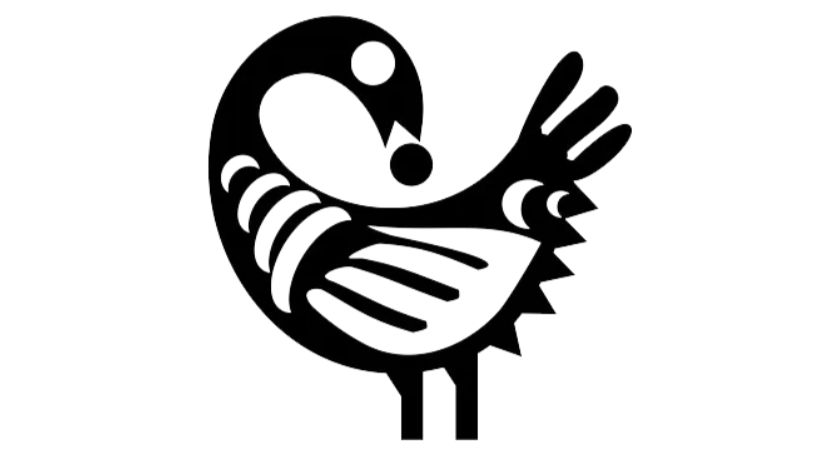
I always love a good word, especially when it comes with a good image. Some words capture whole worlds in their short alphabetic strokes, sometimes even holding a whole range of time, space, and sentiments.
Sankofa is just such a word. The moment I heard it uttered in a recent radio interview I thought: What a word! We need that word!
Sankofa is Ghanaian, coming from the Akan people, from centuries ago, and is both a word and one of their many Adinkra symbols.[1] In the Twi language,[2] san kofa! means “Go back and get it!” – and it carries a positive spin. You forgot something? No problem, there is no harm in returning to retrieve it. In its associated aphorism – se wo were firi na wosan kofa a, yenkyiri[3] – lies a world of wisdom. I am thinking of it in three ways:
First, as an encouragement to hold onto things that we cherish, even if we have to step back. In our hectic lives, when everything charges forward, we have to work harder to hold onto what we value. But that’s okay, just do it – take the time to find what you lost, repair a frayed connection, reground yourself in what you had before. With a little play on words, when everything is on fast-forward, you can shift your gears into past-forward.
Second, it reiterates the value of the past. We talk about the “fleeting” past, but it only fleets if we let it. Even if the past slips out of grasp, we can take steps to reclaim it, to re-own it. Once we realize that we consist of our past as much as our present, and more than our future, we can live a deeper, layered existence. And that lets us see the future more clearly. Hindsight is 20/20 they say – which is to say, hindsight looking back now is foresight.
And third, it reminds us that we can – and should – do two things at once. We can look backwards and forwards at the same time. We must hold onto the past even as we push ahead. When we ground our ambition in our memories and history, in who we are and where we come from, that stable footing lets us go faster and further.
In my international development work,[4] we often talk about “lessons learned” – having learned that not learning our lessons just repeats our failures. But truly and honestly understanding and using our lessons learned is one of the hardest things to do. There is always pressure to keep going, onto the next pilot project or the expected scale-up, always driven to save more lives and improve more livelihoods. We might think that our past, especially our failures, are best left buried. But it is exactly when things are the most urgent, the most critical, that we would do well to pause, to reflect and take care. As my father, who started his career as a medical doctor, always told me: Heed the 19th-century doctor who hailed a carriage and told the driver, “It’s an emergency, it’s an emergency – go slow!”
Sankofa is not the only word that links the future to the past. Other quirks show up elsewhere in the world. Temporally, spatially, it seems, time is what we make of it. How we see the past and the future depends on where we stand.[5]
So, what does this have to do with Sayyida Salme?
I am often struck by how strongly Sayyida Salme’s past, her Zanzibari origins, figured into the rest of her life. The past never let her go – something her family knew when they buried her with the native sand she had kept for many years.
Did she lead a life of sankofa? I would say she practiced sankofa as much as she could, within the choices she made against the barriers of her time. In her choice of husband, and her decision to flee, she was wrenched from her past. And after choosing to raise her children as Germans and Christians to honor her deceased husband, she perpetuated the separation, which took an even greater toll. Even when Sayyida Salme physically returned to Zanzibar after two decades, she became a pawn to colonial powers, who had no qualms about leveraging her past for their purposes. To which we might say, go back and fetch it – if you can. For many who cannot return to their homelands, an absence remains that cannot be filled. It was a life, she wrote, in which she was “consumed by melancholy thoughts of the past and fearful thoughts of our future.” (Letters, p. 67)
But even as she felt the pain of her separation, she also drew sustenance from her past:
When I think back to those lovely days of my youth, a time when I knew only the good and wonderful sides of the world, as yet unaware of the many thorns that would later threaten to block my life at every pass, I get a heavy heart. In my hours of sorrow, however, it is these sacred memories of my youth, memories of parents and siblings, of my homeland, that give me renewed vigor again and again, and I bask myself in them almost daily. (Memoirs, p. 193)
As much as Sayyida Salme held onto her past, though, society also pinned it on her. Anytime she went out, she was made to face the racism and exoticism of the West. Here she was, ready to step up to a new life, a new culture, language, and religion, and yet, she faced more obstacles than opportunities. With such a different past, she bore the strain of othering eyes, and also acutely felt the burden of representing her whole culture and people:
With life made so unbearable, I promised myself, as mentioned, to put all my energy into learning this language, indeed for two reasons: first, to address the helplessness of my situation, as I have described, and second, for fear of you at home, knowing that people here could easily interpret my personal incompetence as generally characteristic of “Arabs.” I was determined to do all I could to learn the customs and habits of the land where I now lived as quickly as possible, in order to keep what many perceived as our primitive upbringing from also being stamped an object of general pity. (Letters, p. 11)
She struggled, yes, and we are the beneficiaries. What makes her writing so interesting is not only that she held onto a history we otherwise would have lost, but that she refracted her past into her present, as a compare-and-contrast lens for us readers way off in the future. Across the stark divide of her before and after leaving the island, she gave us a past-forward prism from which we still have many lessons to learn. Sayyida Salme lived most of her life in this strained duality. But even in all the heaviness of the sankofa that she felt, it was in navigating her past – looking backwards while looking forwards – that Sayyida Salme built her life and expressed herself. It is how she left us such a literary and human legacy of self-expression.
And so I take comfort from the sankofa image that goes with the word - what an apt Adinkra! It shows a bird looking out over its tail, contorted in a way, but bending into a perfect circle – closing the circle, as it were, between past and future into the present. Both feet are sturdy, as this bird solidly stands in a pregnant pause – with an egg in her beak! – to ground our most precious creation: the wholesome, whole-sum growth of ourselves.
Let history surprise you, let her story inspire you – let her authentic voice speak to you!
Andrea Emily Stumpf
May 30, 2026
Image credit: Delphia Simmons from SANKOFA: Time Travel. Sankofa is an Akan Twi word from Ghana… | by Delphia Simmons | Medium (March 2, 2025)
[2] Pronounced “chwee,” here is a good description of its local and diasporic use: Twi Translation Services - Medical and Technical Twi Translation. The word itself is pronounced “san’-koh-fah”, where "san” is to return; “ko” is to go; and “fa” is to fetch – a great three-legged stool.
[3] “If you forget and you go back for it, there is nothing wrong with it.” This and much about sankofa come from "Sankofa: Meaning, Symbolism, and the Wisdom of Looking Back" at Sankofa Symbol – Meaning, History & Images | Adinkra Symbols.
[5] For example, in the Quechua and Aymara languages of Bolivia, the word for “behind” is the same as the word for “future,” and the word for “in front of” is the same as “past” – as in humans walking backwards through life. We see our past, while our unknown future lies behind us. For more, including other examples, see How time flies | Science | The Guardian (February 23, 2005).


Comments